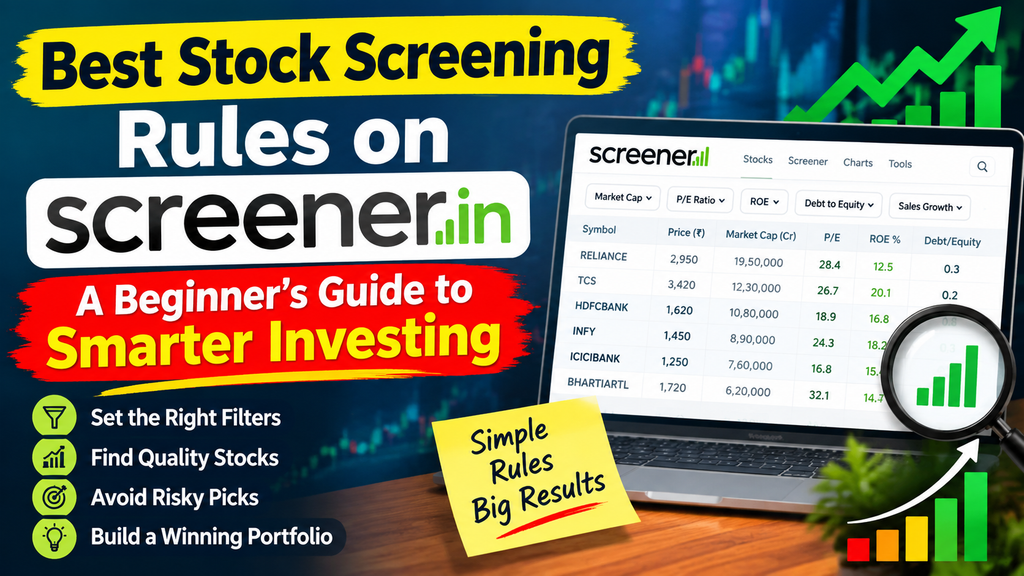
Best Stock Screening Rules on Screener.in: A Beginner’s Guide to Smarter Investing
By Kaushik Brahmakshatriya
Published on 23 September 2026.
Screener.in Stock Screening Rules
Picking the right stocks can feel overwhelming, especially when the market is flooded with thousands of options. That’s where Screener.in Stock Screening Rules come in handy. This free tool helps Indian investors filter companies based on fundamentals like profit growth, debt levels, and valuation ratios. Whether you’re a beginner or a seasoned trader, understanding these screening rules can save hours of research. In this guide, we’ll break down the most effective filters you can use today to build a stronger, smarter portfolio.
What Makes Screener.in So Popular?
If you’ve spent any time in Indian investing forums, you’ve probably heard someone recommend Screener.in. It’s not fancy, but it works. The platform pulls data directly from company financials and lets you build custom queries using simple formulas. You don’t need to be a finance expert — just type in conditions like “ROE > 15” or “Debt to equity < 0.5” and it instantly shows matching stocks.
The best part? Applying solid Screener.in Stock Screening Rules means you’re not chasing tips from random YouTube videos or WhatsApp groups. You’re relying on actual numbers.
Top Screening Rules Every Investor Should Know
Here are some tried-and-tested filters that experienced investors swear by:
1.Return on Equity (ROE) above 15% — shows the company is efficiently using shareholder money.
2.Debt to Equity below 0.5 — keeps you away from companies drowning in loans.
3.Sales growth of 10%+ over 5 years — confirms the business is actually expanding.
4.PEG ratio under 1 — helps spot undervalued growth stocks.
5.Promoter holding above 50% — a sign that founders have real skin in the game.
Combining two or three of these at once usually narrows down thousands of stocks to a manageable, high-quality shortlist. That’s the real power of good Screener.in Stock Screening Rules — they do the heavy lifting so you can focus on final decision-making.
How to Build Your Own Custom Screen
Once you’re comfortable with the basics, try creating your own query. Head to the “Create New Screen” option and combine filters based on your investment style. Long-term investors might prioritize low debt and steady growth, while value hunters may focus more on P/E ratio and book value.
Save your screens too — this way, you can revisit them monthly and track how new companies enter your filtered list as markets shift.
Quick Comparison Table
| Screening Rule | Ideal Value | Why It Matters |
| ROE | Above 15% | Measures profitability efficiency |
| Debt to Equity | Below 0.5 | Lower financial risk |
| Sales Growth (5Y) | 10%+ | Confirms business expansion |
| PEG Ratio | Under 1 | Indicates undervaluation |
| Promoter Holding | Above 50% | Shows founder confidence |
FAQ (Frequently Asked Questions)
Q1. Is Screener.in free to use?
Yes, the basic version is completely free, with a paid plan offering advanced export features.
Q2. Can beginners use Screener.in easily?
Absolutely. Pre-built screens are available, so you don’t need to write formulas from scratch initially.
Q3. How often should I update my stock screens?
Reviewing your screens monthly or quarterly is usually enough to stay updated with market changes.
Q4. Are Screener.in results 100% accurate?
Data is sourced from official filings, but always cross-check before making investment decisions.
Conclusion
Mastering Screener.in Stock Screening Rules doesn’t require a finance degree — just curiosity and consistency. Start with simple filters like ROE and debt ratios, then gradually build more advanced custom screens as you gain confidence. The goal isn’t to find a “perfect” stock but to consistently narrow down quality options backed by real data. Over time, this disciplined approach can genuinely improve your investment decisions and help you avoid impulsive, tip-based trading mistakes that many new investors fall into.
Disclaimer :
This article is for educational purposes only and not financial advice. Stock market investments carry risk. Please consult a certified financial advisor before making any investment decisions based on this content.