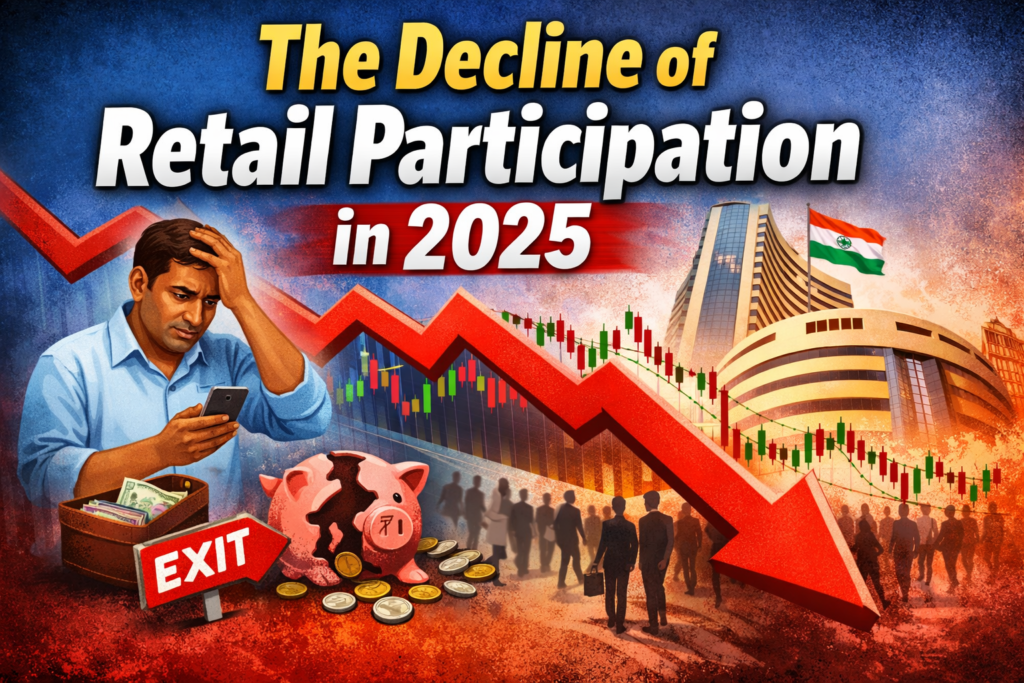
The Decline of Retail Participation in 2025: What’s Really Happening?
25, December 2025. By -Kaushik
As 2025 draws to a close, a noticeable shift is occurring in global stock markets: retail investors — everyday individuals trading through apps like Robinhood or traditional brokers — appear to be pulling back significantly. While overall retail trading volume remains elevated in some areas (accounting for over 20% of U.S. equity activity at times), signs of waning enthusiasm are clear. Reports from research firms like Vanda Research highlight that retail buying during market dips has weakened dramatically since mid-2025, with net selling occurring for the first time in months by late November. This “disappearance” isn’t a complete exit but a marked reduction in aggressive participation, especially in speculative or momentum-driven trades.
This trend contrasts with the post-pandemic boom, where retail investors fueled rallies through “buy-the-dip” strategies. In 2025, however, caution has taken over, driven by a mix of economic pressures, behavioral changes, and structural market shifts. Understanding these reasons is crucial for anyone navigating today’s volatile landscape.
1. Waning Confidence and Reduced “Buy-the-Dip” Conviction
One of the clearest indicators of retail retreat is the drop in conviction during market pullbacks. Throughout much of 2025, retail traders were less eager to scoop up stocks on down days compared to earlier periods. Vanda Research noted some of the weakest retail buying days since May, with cracks emerging in the once-unshakable “buy-the-dip” mantra.
High valuations, concerns over AI bubbles, and fears of overextended tech stocks have made investors hesitant. As one analyst put it, retail participants are now paying closer attention to questions like “Are we in a bubble?” rather than blindly jumping in. This shift from enthusiasm to caution has led to net outflows during corrections and less aggressive positioning overall.
2.Painful Losses and Behavioral Burnout from Past Cycles
Retail investors have taken the brunt of market downturns in recent years. Studies show that average retail performance lags the S&P 500 significantly — often by 5-6% annually — largely because individuals sell during downturns and miss rebounds. In 2025, this pattern continued amid volatility from tariff policies, inflation worries, and sector rotations.
Many who entered during the pandemic boom or meme-stock era faced repeated losses, leading to burnout. High-frequency trading and algorithmic dominance exacerbate this, creating rapid swings that disproportionately hurt less-equipped retail traders. As a result, a growing number have quit active trading, with some estimates suggesting 80% of day traders exit within two years.
3.Shift Toward Private Markets and Alternatives
A major redirection of retail capital is underway: away from public stocks and toward private markets. With easier access via 401(k) changes, fractional ownership platforms, and specialized funds, retail investors are pouring into opaque, illiquid assets like private equity, venture capital, and crypto alternatives.
While this “democratization” promises higher potential returns, it comes with warnings: opacity, high fees, illiquidity, and weak governance make these risky for amateurs. Many retail participants, lured by FOMO around booming private valuations (e.g., OpenAI secondaries), are reallocating away from traditional stocks — contributing to the perceived “vanishing” act in public markets.
4.Economic Pressures and Broader Life Priorities
Rising costs, tax burdens, and economic uncertainty have forced many retail investors to prioritize cash preservation over market exposure. For instance, during early 2025 corrections, some held back funds for IRS deadlines or everyday expenses rather than buying dips.
Younger investors (Gen Z and millennials), who drove much of the retail surge, now face low real income growth and housing unaffordability, limiting disposable capital for trading. This has led to more conservative behavior or complete withdrawal from active investing.
5.Cultural and Attention Shifts in Finance
Crypto and meme-driven hype have cooled, with attention shifting to equities, prediction markets, or AI-related stocks. Platforms like Robinhood now offer 24/7 trading and options, but the “cool factor” of chaotic crypto has faded, reducing speculative retail flows.
In some regions, regulatory changes (e.g., stricter margin rules) have curbed high-risk trading, further dampening participation.
What This Means for the Future of Retail Investing
The “vanishing” retail investor in 2025 isn’t gone forever — participation remains historically high in many metrics. Instead, it’s maturing: from FOMO-driven frenzy to cautious, selective engagement. This could lead to more efficient markets with less noise but also reduced liquidity during stress.
For those still in the game, the lesson is clear: focus on fundamentals, manage risk, and avoid chasing hype. As retail evolves, so does the market — and understanding these shifts could be the key to staying ahead in 2026 and beyond.
Disclaimer:
This blog does not provide financial, investment, or trading advice. All content is for educational and informational purposes only. Please consult a certified financial advisor before making any investment decisions. The author will not be responsible for any financial losses incurred.