US-China G2 Deal 2026: What the Trump-Xi Beijing Summit Really Means for the World
By Kaushik Brahmakshatriya
Published On 16 May 2026.
US China G2 Deal 2026
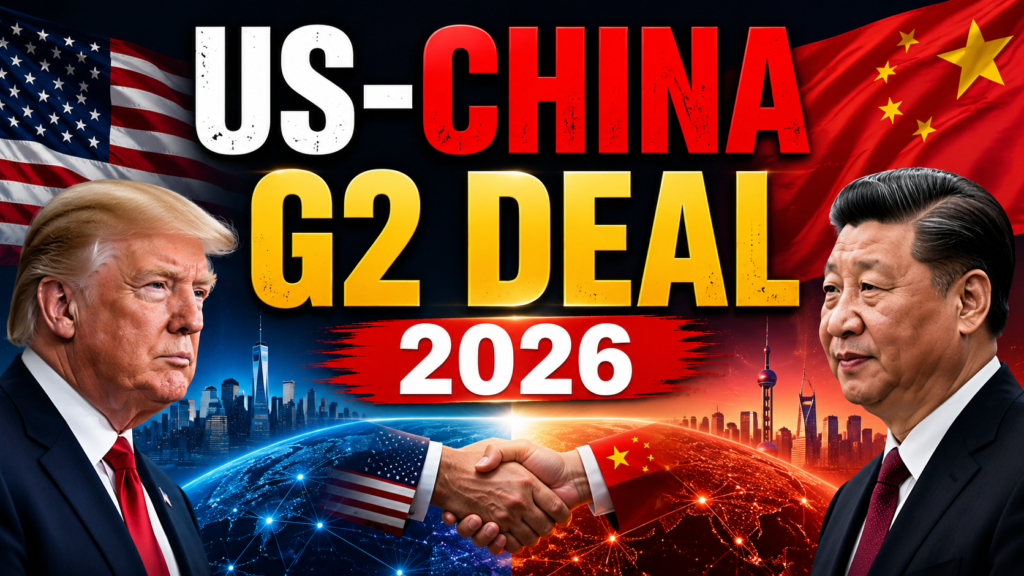
When the two most powerful nations on Earth sit across the same table, the world holds its breath. That is exactly what happened on May 14–15, 2026, when US President Donald Trump landed in Beijing for a two-day state visit with Chinese President Xi Jinping — his first trip to China since 2017. The summit revived one of the most debated concepts in modern geopolitics: the G2, and delivered results that were significant, yet far short of transformative.
What Is the G2 and Why Does It Matter in 2026?
The term G2 — Group of Two was first introduced by American economist Fred Bergsten in 2005. The idea was straightforward: since the United States and China drive nearly half of global economic activity, meaningful cooperation between them alone can stabilize markets, resolve trade disputes, and address pressing global challenges.
The concept gained momentum during the 2008 global financial crisis, when China’s economic firepower played a crucial role in preventing a worldwide recession. It gained new life in 2009 under the Obama-Hu Jintao partnership. However, as geopolitical rivalry replaced economic goodwill through the 2010s, the G2 concept quietly faded.
Trump dramatically revived it at his meeting with Xi in Busan, South Korea, in October 2025 — referring to the two nations openly as a “G2.” The Beijing summit in May 2026 built directly on that foundation, formalizing the language of bilateral supremacy for the first time in years.
G2 — Timeline of a Concept
| Year | Event | Significance |
| 2005 | Fred Bergsten proposes G2 | First formal idea of US-China dual leadership |
| 2008–09 | Global Financial Crisis | G2 gains real-world relevance through coordinated action |
| 2009 | Obama-Hu Jintao Strategic Dialogue | G2 framework briefly institutionalized |
| 2018–2024 | US-China trade and tech war | G2 concept buried under tariffs and rivalry |
| Oct 2025 | Trump-Xi meet in Busan, South Korea | Trump publicly calls the duo “G2”; trade truce begins |
| May 2026 | Trump visits Beijing for 2-day summit | G2 framework gets a 3-year strategic stability roadmap |
What Happened Inside the Beijing Summit?
The atmosphere in Beijing was notably warmer than anyone expected given the bruising tariff battles of 2025. Trump arrived with a delegation that read like a Fortune 500 list — Elon Musk of Tesla, Tim Cook of Apple, Jensen Huang of NVIDIA, Larry Fink of BlackRock, and Boeing CEO Kelly Ortberg were all on board Air Force One.
On the first day, both sides agreed to develop what Beijing officially called a “constructive China-US relationship of strategic stability” — a framework meant to guide the two nations for at least the next three years. Trade envoys had met the day before in a preparatory session led by US Treasury Secretary Scott Bessent and Chinese Vice Premier He Lifeng, producing what Xi described as “overall balanced and positive outcomes.”
The Boeing Deal became the summit’s most visible headline. China confirmed it would purchase 200 Boeing aircraft — a meaningful step given that US-China aviation commerce had completely dried up after 2017. Yet the number disappointed investors who had been expecting 500 planes, and Boeing’s stock fell 4% on Wall Street by day’s end.
Beyond aviation, both sides pledged improved use of diplomatic and military communication channels, greater agricultural and tourism cooperation, and expanded market access. However, no sweeping trade deal was signed.
Beijing Summit 2026 — Agenda vs. Actual Outcome
| Agenda Topic | US Goal | Outcome |
| Boeing Aircraft Purchase | 500 jets minimum | 200 jets confirmed; below expectations |
| Trade Deal / Tariff Framework | Formal agreement | 3-year “strategic stability” framework; no binding deal |
| Taiwan | Maintain current US position | 3-year “strategic stability” framework; no binding deal |
| Iran & Strait of Hormuz | China to pressure Tehran | Beijing declined concrete commitment |
| Semiconductor Exports (NVIDIA H200) | Expand China access | Partially; entity-list restrictions remain in place |
| Rare Earth Minerals | Lift export controls | No resolution; still under negotiation |
| Agriculture & Soybeans | Major purchase agreement | Cooperation pledged; no specific figures announced |
Taiwan: The Summit’s Sharpest Moment
No issue cut deeper at the Beijing talks than Taiwan. Xi made Beijing’s position unmistakably clear — Taiwan is the “most important issue” in the US-China relationship and could lead to serious conflict if handled carelessly.
The statement was blunt, even by diplomatic standards. US Secretary of State Marco Rubio was quick to respond, telling NBC News that “US policy on Taiwan is unchanged,” adding that Beijing always raises the issue and Washington always holds its ground. Taiwan’s Foreign Minister publicly thanked Rubio for the clarity.
The exchange captured the fundamental tension at the heart of the G2 project: the two nations can stabilize markets and sign aircraft deals, but on matters of sovereignty and security, the distance between Washington and Beijing remains vast.
What This G2 Moment Means for India and Other Nations
For countries watching from the sidelines, the revival of G2 carries a specific kind of anxiety. India, in particular, has much to lose from a tight US-China bilateral arrangement.
For over two decades, Washington used its relationship with New Delhi as a strategic counterweight to Beijing in the Indo-Pacific. But a G2-style partnership repositions China as Washington’s preferred co-pilot — not a rival to be balanced. India faces a scenario where its strategic value to the US could quietly diminish precisely when its own trade relationship with Washington is already under stress from Trump’s tariff policies.
The broader Indo-Pacific region shares this unease. Governments from Tokyo to Singapore want a US-China relationship calm enough to prevent conflict, but not so close that major global decisions get made exclusively between Washington and Beijing — bypassing everyone else.
US-China G2 — Impact on Key Countries and Regions
| Region / Country | Concern | Likely Impact |
| 🇮🇳 India | Loss of strategic leverage with the US | Supply chain gains and Indo-Pacific importance may weaken |
| 🇹🇼 Taiwan | Risk of US making concessions to Xi | Increased uncertainty over long-term US security commitment |
| 🇯🇵 Japan & South Korea | Fear of being sidelined in US-China deals | Increased uncertainty over long-term US security commitment |
| 🇸🇬 Southeast Asia | Supply chain and trade disruption | May benefit from China+1 diversification if tensions persist |
| 🇪🇺 European Union | Excluded from G2 framework | Pressure to build independent trade and tech policy |
| 🌍 Global Markets | Tariff unpredictability | Short-term relief; long-term structural uncertainty continues |
The Bigger Picture: Stabilization Is Not Peace
The 2026 Beijing summit delivered something real but something limited. Both nations stepped back from the brink of a full-blown economic rupture. A three-year stability roadmap gives businesses some planning horizon. The Boeing deal, however modest, signals resumed commercial engagement.
But underneath the surface, the structural conflicts remain entirely intact. The US still restricts Chinese access to advanced semiconductors. China still controls rare earth supply chains that American industry depends on. Taiwan remains a potential flashpoint. The Iran crisis has created fresh geopolitical fault lines. And both nations continue to invest aggressively in competing technological ecosystems — one centered in Silicon Valley, one emerging from Shenzhen and Beijing.
The G2 framework is not a solution to these contradictions. It is a managed pause — a diplomatic agreement to compete more carefully rather than crash into each other recklessly. For a world that has spent the last decade watching two superpowers throw economic punches at each other, a managed pause is valuable. But it should not be mistaken for a lasting settlement.
The G2 story of 2026 is ultimately about two great powers acknowledging something they have resisted for years: that no matter how fierce the rivalry, they still need each other — and the world needs them both to behave responsibly.
Frequently Asked Questions (FAQ)
Q1: What is the G2 deal between the US and China in 2026?
The G2 refers to the concept of the United States and China acting as the world’s two dominant economic powers. In May 2026, Trump and Xi met in Beijing and agreed on a “strategic stability” framework to guide their relationship for the next three years, making it the most formal acknowledgment of the G2 dynamic in recent history.
Q2: What was the biggest outcome of the Trump-Xi Beijing summit?
China agreed to purchase 200 Boeing aircraft — the first major aviation deal since 2017. Both nations also committed to a three-year strategic stability framework, improved communication channels, and deeper trade cooperation. However, no comprehensive trade deal was signed.
Q3: How does the US-China G2 summit affect India?
The G2 framework raises concerns for India because a closer US-China partnership may reduce India’s strategic importance to Washington. India’s role as a counterbalance to China in the Indo-Pacific could weaken if the two superpowers become too closely aligned, while India simultaneously faces tariff pressures from the US.
Q4: Is the G2 an official international organization?
No. The G2 is a conceptual and informal framework, not a formal institution like the G7 or G20. It describes a pattern of bilateral leadership between the US and China on global issues, rather than a structured organization with rules and membership.
Q5: What issues were NOT resolved at the Beijing summit?
Key unresolved issues include: semiconductor export restrictions on China, rare earth mineral export controls, the Taiwan dispute, China’s position on the Iran war, and the final structure of tariffs between the two countries.
Q6: What did Xi Jinping say about Taiwan at the summit?
Xi told Trump directly that Taiwan is the “most important issue” in the US-China relationship and warned it could lead to serious conflict if mishandled. The US maintained that its Taiwan policy remains unchanged, and Taiwan’s government welcomed that clarification.
Disclaimer:
This blog does not provide financial, investment, or trading advice. All content is for educational and informational purposes only. Please consult a certified financial advisor before making any investment decisions. The author will not be responsible for any financial losses incurred