Iran-America War & Indian Stock Market: Which Sectors Rise and Which Fall? (2026 Guide)
By Kaushik Brahmakshatriya
Published On 15 June 2026.
Indian stock market sectors Iran America war
When war breaks out in the Middle East, Dalal Street does not wait. The moment geopolitical tension escalates, Indian investors witness sharp, decisive moves across sectors — some crash instantly while others quietly surge. The Iran-America conflict that intensified in early 2026 offered a live masterclass in how Indian markets respond to war. Understanding these patterns is essential for every investor who wants to protect their portfolio and identify hidden opportunities during global crises.
Why the Iran-America War Directly Impacts India’s Stock Market
India is not a party to the conflict, yet it feels the effects almost immediately. The reason is structural. India depends on imported crude oil for over 85–90% of its energy needs, and the Strait of Hormuz — through which roughly 20% of global oil flows — was disrupted when the US-Iran conflict escalated. (5paisa) This single chokepoint connects India’s inflation rate, rupee value, corporate earnings, and equity valuations to every military development in the Persian Gulf.
According to Goldman Sachs, Indian companies may be among the most impacted in Asia by the Iran war, estimating that a 20% rise in Brent crude prices could cut regional earnings by 2%. Societe Generale and Natixis similarly flagged India’s assets as “most at risk” due to its high energy import dependency.
This vulnerability, however, cuts both ways. When fear dominates, certain Indian sectors become magnets for investor capital. And when the ceasefire arrives, the Sensex climbed over 3.7% and the Nifty surged more than 3.5%, with real estate, auto, banking, and pharma stocks gaining up to 6%.
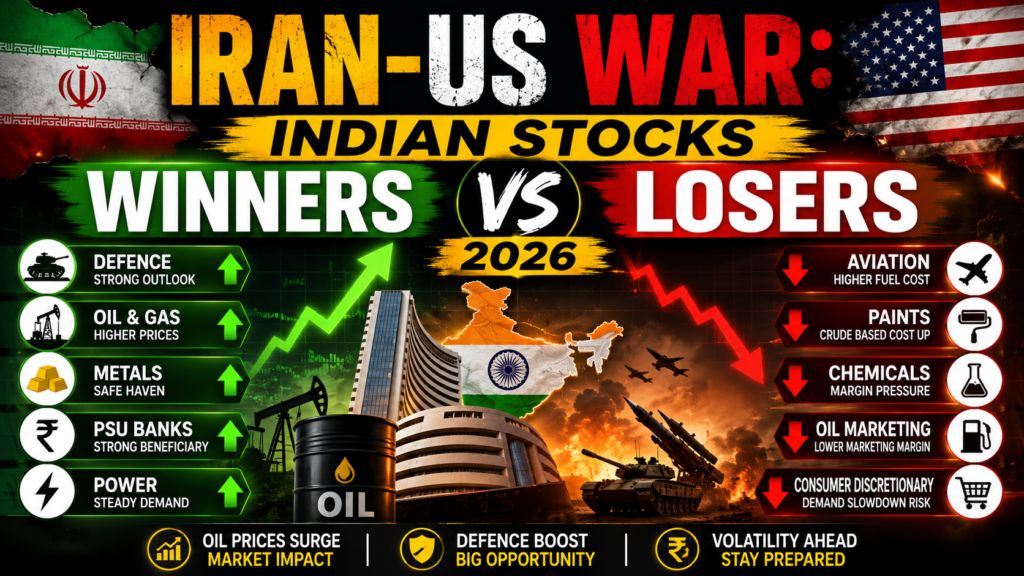
Sectors That RISE During the Iran-America War
1. Defence Sector — The Biggest War-Time Winner
India’s defence public sector undertakings (PSUs) and private defence manufacturers see the strongest upside during geopolitical conflicts. The Nifty India Defence Index rallied more than 5% during the March 2026 geopolitical crisis, even as the Nifty 50 fell 11%.
Companies like BEL (Bharat Electronics Limited), HAL (Hindustan Aeronautics Limited), and BDL (Bharat Dynamics Limited) benefit from increased government defence spending as tensions rise globally. The shift in modern warfare towards technology-led systems such as AI-enabled autonomous platforms, drone swarms, and cyber warfare is creating a structural long-term opportunity for domestic defence companies with electronic warfare capabilities.
2. Gold & Silver — Classic Safe Havens
Every war triggers a flight to safety. Geopolitical tensions have led to a spike in demand for safe-haven assets like gold and silver. Oil prices surged 9–10% in just one week as the US-Iran conflict caused fears of supply disruption, particularly with threats to close the Strait of Hormuz.
MCX (Multi Commodity Exchange of India) stands out as an indirect beneficiary. MCX, which derives over 95% of its revenue from bullion and energy products, benefits from higher trading volumes as hedgers and speculators flood into gold, silver, and crude oil markets during war-driven price volatility.
Silver offers a double benefit during war — it functions as a safe haven during fear, while also benefiting from rising demand in defence equipment, solar panels, electric vehicles, and electronics.
3. Oil & Gas Exploration (ONGC, Oil India)
When crude prices spike, upstream producers collect more revenue per barrel. Defence companies like BEL, HAL, and BDL earn more because governments buy more weapons, while ONGC and Oil India earn more because crude prices rise.
However, this is a temporary gain — when the ceasefire arrives, energy stocks correct sharply as oil prices fall.
4. FMCG & Pharma — Defensive Safe Harbours
These sectors do not necessarily profit from war, but they hold their value when everything else is falling. Analysts noted that consumer goods and pharmaceutical sectors remained relatively insulated during the March 2026 market crash, even as aviation, paint, and banking stocks fell sharply.
Their domestic demand base shields them from global oil price fluctuations, making them reliable defensive positions in a war-period portfolio.
Sectors That FALL During the Iran-America War
Sectors hit hardest by the conflict include Middle East-exposed banks, automobile companies, oil marketing companies (OMCs), IT firms, and consumer durables — all affected by crude oil price spikes.
Aviation takes one of the hardest hits because jet fuel costs are directly tied to crude oil. Paint companies like Asian Paints and Berger suffer because crude derivatives form a major raw material input. Automobile manufacturers face margin pressure from higher input costs. Domestic tyre players are particularly vulnerable as they use crude derivatives as a major production input, while export-heavy automotive players also face higher shipping costs.
Indian Stock Market Sectors — War vs. Post-War Performance
| Sector | During War (Iran Conflict) | After Ceasefire | Key Stocks |
| Defence | ↑ Rallied 5%+ (Nifty Defence Index) | ↓ Correction | BEL, HAL, BDL, MTAR |
| Gold / MCX | ↑ Strong surge | ↓ Moderate pullback | MCX, Sovereign Gold Bonds |
| Oil Exploration (ONGC) | ↑ Higher crude = higher revenue | ↓ Correction as oil falls | ONGC, Oil India |
| FMCG & Pharma | ↔ Relatively stable (safe haven) | ↑ Bounce back | Sun Pharma, HUL, ITC |
| Aviation | ↓ Heavy losses (jet fuel spike) | ↑ Sharp rebound (IndiGo +10%) | IndiGo, Air India |
| Banking & Financials | ↓ Fell on rate uncertainty | ↑ Led post-ceasefire rally | HDFC Bank, Bajaj Finance |
| IT / Technology | ↓ Weak (global demand concerns) | ↔ Slow recovery | TCS, Infosys, Tech Mahindra |
| Real Estate | ↓ Initial weakness | ↑ Strong rebound post-ceasefire | DLF, Macrotech |
| Auto | ↓ Margin pressure from crude | ↑ Strong rebound (Tata Motors +8.7%) | Maruti, Tata Motors, M&M |
| Paint & Chemicals | ↓ Input cost surge | ↑ Gradual recovery | Asian Paints, Berger |
Key Market Events — Iran-America War Timeline & Sensex Impact (2026)
| Date | Event | Sensex Reaction | Key Movers |
| Late Feb 2026 | US-Iran conflict escalates after Khamenei killing | Sensex crashes sharply | OMCs, auto, IT fell |
| March 2, 2026 | L&T and TCS slide; Middle East exposure feared | Nifty fell ~11% at peak | L&T, TCS, KEC International |
| March 25, 2026 | US proposes ceasefire terms; oil risk eases | Sensex +1.6%, Nifty +1.7% | Titan +4.7%, L&T +4%, Bajaj Finance |
| April 8, 2026 | Two-week US-Iran ceasefire confirmed | Sensex +3.7%, Nifty +3.5% | IndiGo +10%, L&T +7.1%, Tata Motors +8.7% |
| April 9, 2026 | Ceasefire doubts resurface; oil spikes again | Sensex slips 0.6% | HDFC Bank, ICICI fell; BEL, KEC rose |
The Post-Ceasefire Playbook — What Rallies When Peace Returns
The market’s reaction to the ceasefire announcement was swift and powerful. When the US-Iran ceasefire was confirmed in April 2026, IndiGo led gains with an 8.2% surge. Other major winners included L&T, Adani Ports, Bajaj Finance, Bajaj Finserv, UltraTech Cement, Maruti Suzuki, Mahindra & Mahindra, Axis Bank, and HDFC Bank, all rising between 5% and 7.6%.
The ceasefire reduced the risk of supply disruptions in one of the world’s most important oil-producing regions. Lower geopolitical risk drove lower oil prices, and lower oil prices positively impacted India’s inflation outlook and stock market valuations in a chain reaction.
The pattern is consistent: sectors crushed during war become the biggest winners once peace returns. Aviation, auto, banking, and real estate historically show the sharpest recovery because they were oversold during the conflict period. Based on historical patterns, auto, financials, and metals could again lead the recovery phase after geopolitical conflicts resolve.
FAQ Section: Iran-America War & Indian Stock Market
Q1. Which Indian sector benefited the most during the Iran-America war in 2026?
The defence sector was the clearest winner. The Nifty India Defence Index gained over 5% during the March 2026 crisis when the broader Nifty 50 was down nearly 11%. Stocks like BEL, HAL, and BDL outperformed the market significantly during peak war tensions.
Q2. Should investors sell their portfolio when the Iran-America war escalates?
Panic selling is rarely the right strategy. Long-term SIP investors should continue their investments. The market has shown that post-ceasefire recoveries are sharp and fast. Selling in panic means missing the rebound. The smarter approach is to reduce exposure to high-risk sectors like aviation and OMCs, and increase allocation to gold, pharma, and FMCG temporarily.
Q3. How does the Iran-America war affect crude oil prices in India?
The Strait of Hormuz is a critical global oil transit route. Any disruption caused by the Iran conflict immediately pushes global crude prices higher. Since India imports over 85–90% of its crude oil, higher oil prices raise fuel costs, widen the fiscal deficit, weaken the rupee, and increase inflation — all of which hurt corporate margins and equity valuations.
Q4. What happened to the Sensex after the Iran-America ceasefire in April 2026?
The Sensex jumped nearly 4%, rising approximately 3,000 points in a single session on April 8, 2026 after the ceasefire announcement. Sectors like aviation, auto, banking, and real estate led the recovery. IndiGo surged 10%, Tata Motors rose 8.7%, and L&T gained 7.7%.
Q5. Is gold a good investment during the Iran-America conflict?
Yes. Gold and silver are classic safe-haven assets that investors buy when geopolitical uncertainty rises. During the 2026 Iran conflict, gold prices rose significantly alongside oil. MCX, India’s largest commodity exchange, also saw higher trading volumes and revenue, making it an indirect beneficiary.
Q6. Which IT and banking stocks recovered fastest after the ceasefire?
Among IT stocks, TCS and Infosys had been under pressure during the conflict but began recovering as oil prices fell. On the banking side, HDFC Bank, ICICI Bank, Bajaj Finance, and Axis Bank were among the fastest recoverers when the ceasefire was announced, with Bajaj Finance gaining over 7% in a single session.
Q7. What is the best long-term strategy for Indian investors during Middle East wars?
Maintain a diversified portfolio with 60–65% in quality domestic demand companies (banking, FMCG, pharma, IT), 10–15% in gold or silver ETFs as a hedge, and 5–10% in defence PSUs as a structural allocation. Avoid overreacting to short-term volatility and use deep dips in aviation, auto, and real estate as entry opportunities for long-term wealth creation.
Disclaimer: This article is for educational and informational purposes only. It does not constitute financial advice. Please consult a SEBI-registered financial advisor before making investment decisions.we are not responsible any loss