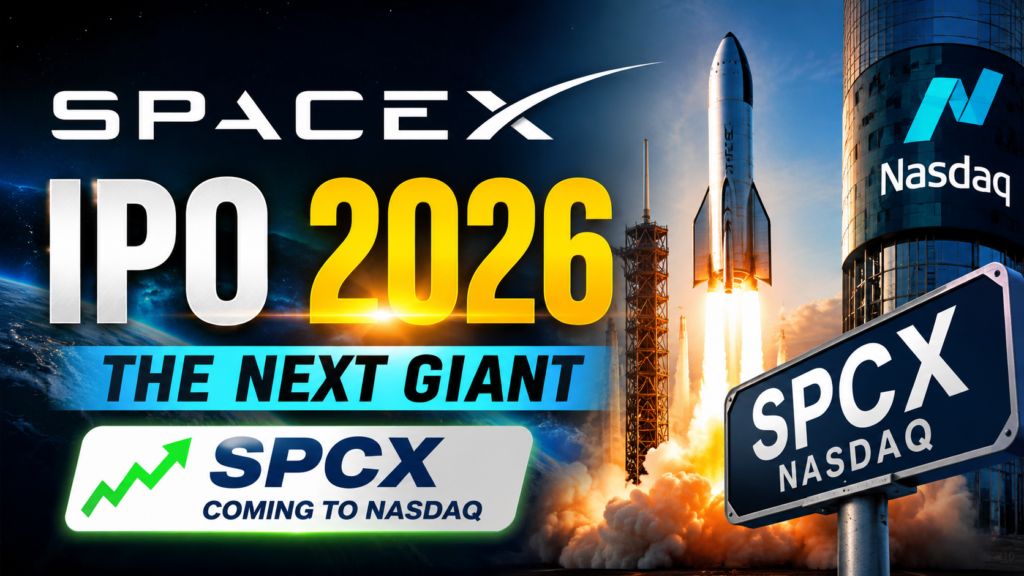
SpaceX IPO 2026: SPCX Stock Listed on Nasdaq — Everything Investors Need to Know
By Kaushik Brahmakshatriya
Published On 14 June 2026.
SpaceX IPO 2026
On June 12, 2026, Elon Musk’s Space Exploration Technologies Corp. — better known as SpaceX — officially went public on the Nasdaq Stock Exchange under the ticker symbol SPCX. This was not just another IPO. It was the single largest initial public offering in the history of global financial markets, surpassing Saudi Aramco’s $35.4 billion debut in 2019.
SpaceX priced its shares at $135 per share, targeting a raise of $75 billion at a staggering valuation of $1.75 trillion. On its very first trading day, the stock opened at $150 and closed at $161 — a jump of nearly 19% above IPO price — sending shockwaves across the investment world.
After 24 years as a private company, SpaceX’s public listing marks a defining moment not just for the space industry, but for global investing as a whole.
What Is SpaceX? A Quick Company Overview
Founded in 2002 by Elon Musk, SpaceX was built with a single bold mission: to make humanity a multi-planetary species. Over two decades, the company evolved from a small rocket startup into a multi-segment aerospace and technology giant.Its three core business divisions are:
- Space (Launch Services): Falcon 9 rockets, Dragon spacecraft, and the Starship program for deep-space exploration
- Connectivity (Starlink): A satellite internet network serving over 9 million subscribers worldwide, generating approximately 61% of total 2025 revenues
- AI (SpaceXAI): Following SpaceX’s all-stock acquisition of Elon Musk’s xAI company in February 2026 — valued at approximately $250 billion — the AI division was rebranded as SpaceXAI and fully absorbed into SpaceX
This combination of rockets, satellite internet, and artificial intelligence positions SpaceX unlike any other company trading on global markets today.
SpaceX IPO Key Details at a Glance
| Detail | Information |
| IPO Date | June 12, 2026 |
| Stock Exchange | Nasdaq |
| Ticker Symbol | SPCX |
| IPO Price | $135 per share |
| Opening Price | $150 per share |
| Closing Price (Day 1) | ~$161 per share |
| Market Cap at IPO | ~$1.75 Trillion |
| Total Shares Offered | 555.56 million Class A common shares |
| Funds Raised | ~$75 billion |
| Lead Underwriter | Goldman Sachs |
| Retail Share Allocation | ~30% (vs typical 5–10%) |
SpaceX Financial Performance: Revenue & Profitability
SpaceX’s financials have grown at a remarkable pace, largely on the back of Starlink’s explosive subscriber growth. Here is a summary of the company’s key financial metrics:
| Financial Metric | 2024 | 2025 |
| Total Revenue | ~$15–16 Billion | ~$18.67 Billion |
| Starlink Revenue | ~$7.7 Billion | ~$11–12 Billion (est.) |
| Adjusted EBITDA | N/A | $6.58 Billion |
| Operating Loss | N/A | ~$5 Billion (inc. xAI integration) |
| Q1 2026 Revenue | — | $4.7 Billion (3 months ended March 31) |
| Starlink Subscribers | ~5 Million | 9+ Million |
| Government Contracts | ~$2 Billion | ~$3 Billion (est.) |
Starlink alone contributed roughly 61% of SpaceX’s total 2025 revenues, making it the engine driving the company’s entire valuation story. The military-grade version of Starlink, called Starshield, has seen growing demand globally, including extensive use in active conflict zones.
Why This IPO Is Different: Retail Investor Access
Most mega-IPOs reserve only 5–10% of shares for everyday retail investors, with the bulk going to institutional hedge funds and asset managers. SpaceX broke this mold entirely.
For the SPCX IPO, approximately 30% of shares were set aside for retail investors — roughly three times the industry norm. This made SPCX accessible through major brokerage platforms including Robinhood, Fidelity, Charles Schwab, SoFi, and E*TRADE.
Despite this generous allocation, demand was so overwhelming that most retail applications were only partially filled or not filled at all. Investors who missed the allocation could still buy SPCX shares on the open Nasdaq market from June 12 onwards, though at prices well above the $135 IPO price.
SpaceX Growth Drivers: What Makes SPCX Worth Watching
Three powerful long-term trends support SpaceX’s growth story:
1. Global Space Economy Expansion
The global space economy is projected to reach $1 trillion by 2034, up from $626 billion in recent years. As the market leader in commercial launches and satellite internet, SpaceX is positioned to capture an outsized share.
2. Starlink Direct-to-Cell Technology
Starlink’s next phase of growth comes from direct-to-cell satellite connections — allowing smartphones to connect to satellites without special hardware. This massively expands the addressable market beyond fixed broadband customers.
3. Starship Program & Deep Space Missions
SpaceX’s Starship — described as the most powerful rocket ever built — is being developed for lunar missions under NASA contracts, and ultimately for crewed missions to Mars. Successful Starship commercialization could transform SpaceX’s revenue potential entirely.
Q&A: Your SpaceX IPO Questions Answered
Q1. When did SpaceX go public and on which exchange?
SpaceX officially began trading on June 12, 2026, on the Nasdaq Stock Exchange under the ticker symbol SPCX.
Q2. What was the SpaceX IPO share price?
The IPO was priced at $135 per share. On the first day of trading, it opened at $150 and closed at approximately $161, representing a gain of nearly 19%.
Q3. What is SpaceX’s market capitalization after the IPO?
At its IPO price of $135, SpaceX was valued at approximately $1.75 trillion. After the first-day price surge, the market cap crossed the $2 trillion mark.
Q4. Is SpaceX a profitable company?
SpaceX as a whole posted an operating loss in 2025, partly due to the integration costs related to the xAI acquisition. However, its Starlink satellite internet division is the company’s only fully profitable segment and its largest revenue driver.
Q5. Can Indian investors buy SPCX shares?
Indian investors can buy SPCX shares through the Liberalised Remittance Scheme (LRS), which allows remittance of up to $250,000 per year for overseas investments. Platforms such as INDmoney, Vested, and Groww’s US stocks feature support trading in Nasdaq-listed stocks including SPCX.
Q6. What is Starlink and why does it matter for SpaceX’s valuation?
Starlink is SpaceX’s satellite internet service. With 9 million+ subscribers and revenue exceeding $11 billion in 2025, Starlink is SpaceX’s most profitable business unit and the primary reason the company commands such a premium valuation.
Q7. Did Elon Musk retain control of SpaceX after the IPO?
Yes. SpaceX uses a dual-class share structure, which means Elon Musk retains majority voting control over the company despite the public listing.
Q8. What are the key risks of investing in SPCX stock?
Key risks include: heavy dependence on Starlink’s continued growth, Elon Musk’s concentrated voting power limiting shareholder influence, reliance on US government contracts, execution risk in the Starship program, and competition in the satellite broadband space from Amazon’s Kuiper and others.
Final Thoughts: Should You Invest in SPCX?
The SpaceX IPO is unlike anything global markets have seen before. A company that combines reusable rockets, satellite internet, and artificial intelligence — all led by one of history’s most ambitious entrepreneurs — arriving on the public market at $1.75 trillion in valuation is genuinely historic.
That said, at over 100x trailing revenues, SPCX demands sustained exceptional performance from every division. Investors should research carefully, assess their risk appetite, and consider the dual-class share governance structure before investing. As always, speak to a SEBI-registered financial advisor before making investment decisions.
Disclaimer: This article is for informational purposes only and does not constitute financial or investment advice.we are not resposible for any loss.